
In a February 3, 2026, Barchart article that asked if the risk in gold and silver was too high and what mining shares were signaling, I concluded with the following:
Gold and silver prices remain at historical highs, above levels in late 2025, keeping a bid under mining shares. Therefore, the leading gold and silver mining shares add uncertainty to the path of least resistance for the underlying metals. Keep an eye on the miners’ performance over the coming days and weeks, as they could provide clues about the metal’s price direction. However, at $4,700 for gold and over $75 for silver, the miners will continue to earn substantial profits.
Don’t Miss a Day: From crude oil to coffee, sign up free for Barchart’s best-in-class commodity analysis.
I am not bullish on gold, silver, and the mining shares after the latest correction. However, I do believe the market has moved from a speculative buying frenzy to a period where trading with disciplined risk-reward dynamics could yield substantial profits, as volatility creates a paradise for nimble traders with their fingers on the pulse of moving markets.
Silver was trading at $78.91 per ounce on the nearby COMEX futures contract on February 2. In early March, the price is over $4 higher, as silver has recovered but faces resistance at the $92.50 midpoint.
Explosive price action and a correction
The daily continuous COMEX silver futures chart highlights the extreme price volatility over the past months.
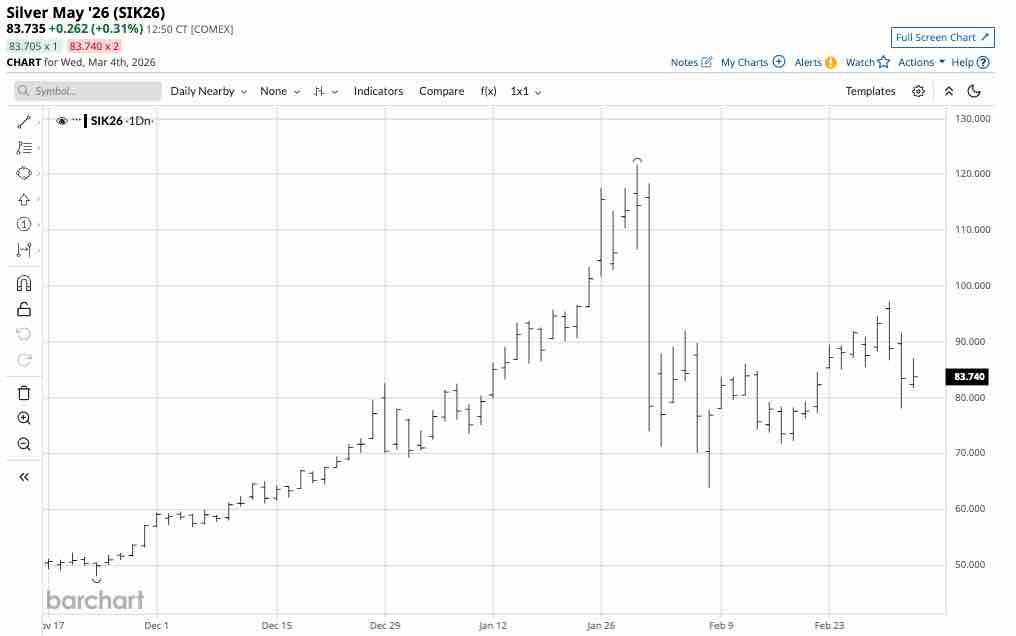
The chart shows that nearby COMEX silver futures rose 72.5%, from the December 31, 2025, closing price of $70.603 to the January 29, 2026, all-time high of $121.785 per ounce. On February 6, 2026, silver reached a low of $63.90, a 47.5% correction.
The recovery has been choppy but orderly
After the wild volatility that gripped the silver futures market in late 2025 when it broke through the 1980 high and through late January 2026 when the price eclipsed $120 per ounce and the subsequent late January early February correction, silver’s price recovery has been orderly.
As the chart illustrates, silver’s price has made higher lows and higher highs since early February, climbing above $90 per ounce in late February and over $97 in early March before falling below $84 per ounce.
The case for higher silver prices
The case for higher silver prices includes:
- Silver remains in a long-term bullish trend after rising above its 1980 high of $50.36 per ounce in 2025.
- Silver demand, speculative and industrial, has exploded higher. The Silver Institute forecast a 117.70 million ounce deficit with demand outstripping supply in 2025.
- Silver is a highly speculative metal, attracting substantial buying interest when the price rose to a new record high in 2025.
- The Silver Institute reports that it expects global silver demand to remain “largely unchanged in 2026, as healthy gains in retail investment are likely to offset most of the losses across other key demand segments, notably in jewelry, silverware, and industrial demand.”
- A weak U.S. dollar and the prospects for falling U.S. interest rates are historically bullish for silver prices.
- Silver’s 1980 high of $50.36 per ounce translates to nearly $200 per ounce based on the cumulative rate of inflation.
- Mexico is the world’s leading silver-producing country, producing nearly twice the amount as second-place China.
While silver remains in a bullish trend with favorable supply-demand fundamentals, the price has risen to a level that has increased volatility.
The caution- Silver is a highly volatile and speculative metal
Silver tends to be twice as volatile as gold, on a percentage basis. Monthly historical gold volatility in early March at 17.06% is over half that of silver’s historical volatility at 36.53%. The following factors could derail silver’s rally:
- Given the price rise, substantial individually held silver stockpiles could be sold to refiners, increasing supplies over the coming months.
- Long liquidation and profit-taking in long-held silver risk positions could weigh on prices.
- At over $80 per ounce, and after the recent violent correction, the risk of long positions in the silver futures market has increased.
While silver remains bullish, and higher highs could be on the horizon, careful attention to risk-reward dynamics is required for any long or short risk position.
Silver mining stocks have kept pace with silver since the early February low
The two leading diversified silver mining ETFs are the GX Silver Miners ETF (SIL), which holds shares in leading senior silver mining companies, and the Amplify Junior Silver Miners ETF (SILJ), which holds shares in top junior silver mining and exploration companies.
COMEX silver futures rose 141.44% in 2025, and moved another 72.5% higher from the end of last year to the January 2026 high, before experiencing a 47.5% correction. At $83.184 per ounce on March 4, silver recovered by 30.2 from the February 6 low.
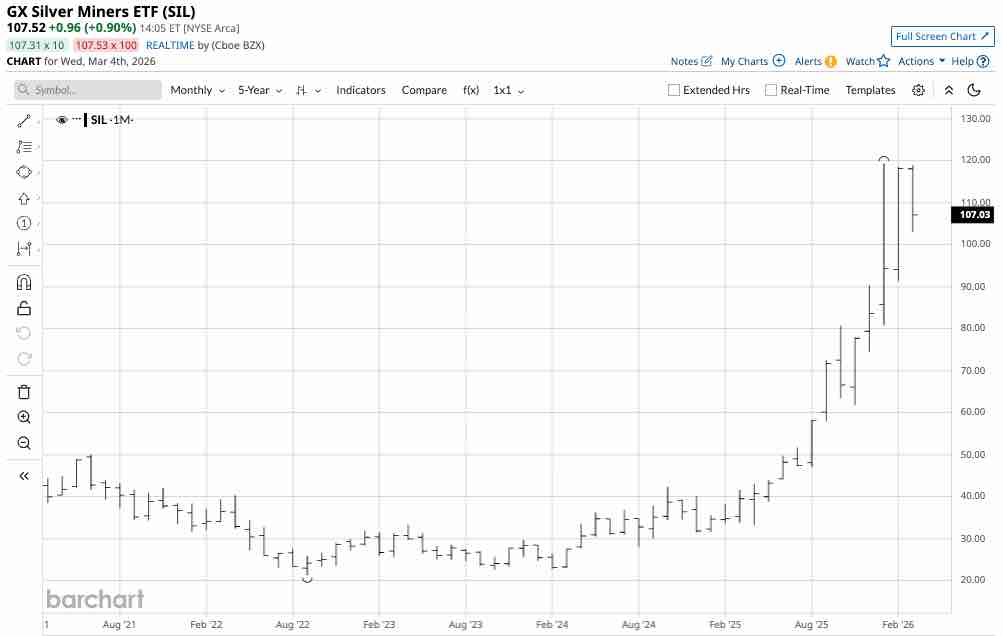
The five-year monthly chart of the SIL ETF shows that it rose 162.9% in 2025, moved 42.8% higher in early 2026 to the late January high. SIL then corrected by 32.3% and moved 33.12% higher by March 4.
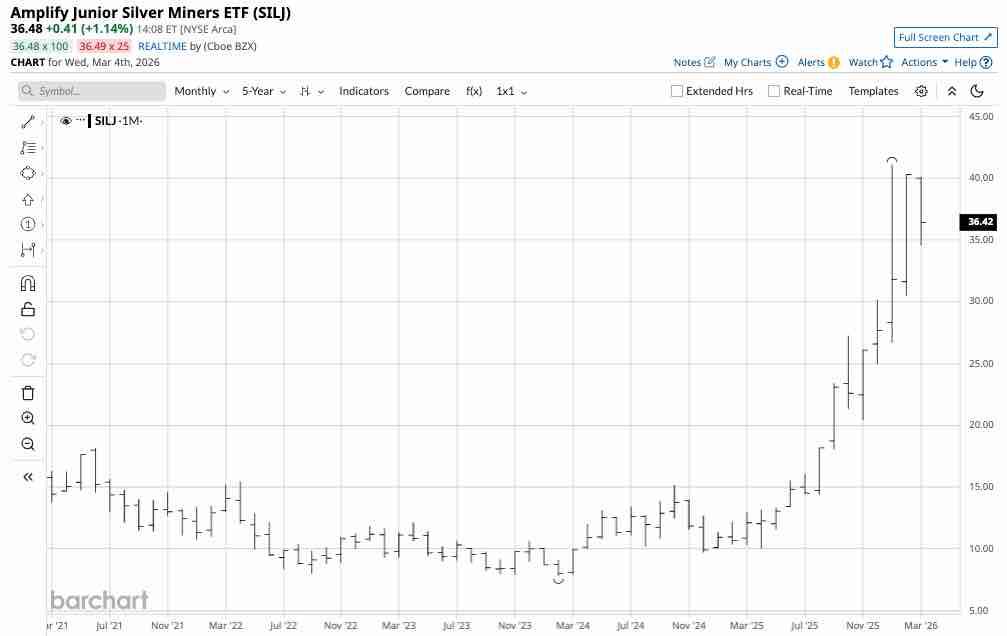
The five-year monthly chart of the SILJ ETF shows it rose 178.6% in 2025, and 48.5% higher in early 2026 to the late January high. SILJ then corrected by 35.1% and moved 36.78% higher by March 4.
I view the similar performance of silver futures and the senior and junior silver mining ETFs as a positive sign of continued speculative investment demand for silver. In 2025, the mining shares outperformed silver, signaling robust investment demand. SIL and SILJ underperformed silver from the end of 2025 to the late January 20926 high, which turned out to be a warning signal. During the correction, the mining shares outperformed silver futures, a sign that market participants bought the senior and junior mining shares. Since the low, the mining shares have kept pace with silver futures prices.
Keep an eye on the performance of mining shares versus silver futures, as it could provide clues about the path of least resistance of silver prices over the coming days, weeks, and months.
On the date of publication, Andrew Hecht did not have (either directly or indirectly) positions in any of the securities mentioned in this article. All information and data in this article is solely for informational purposes. For more information please view the Barchart Disclosure Policy here.
More news from Barchart